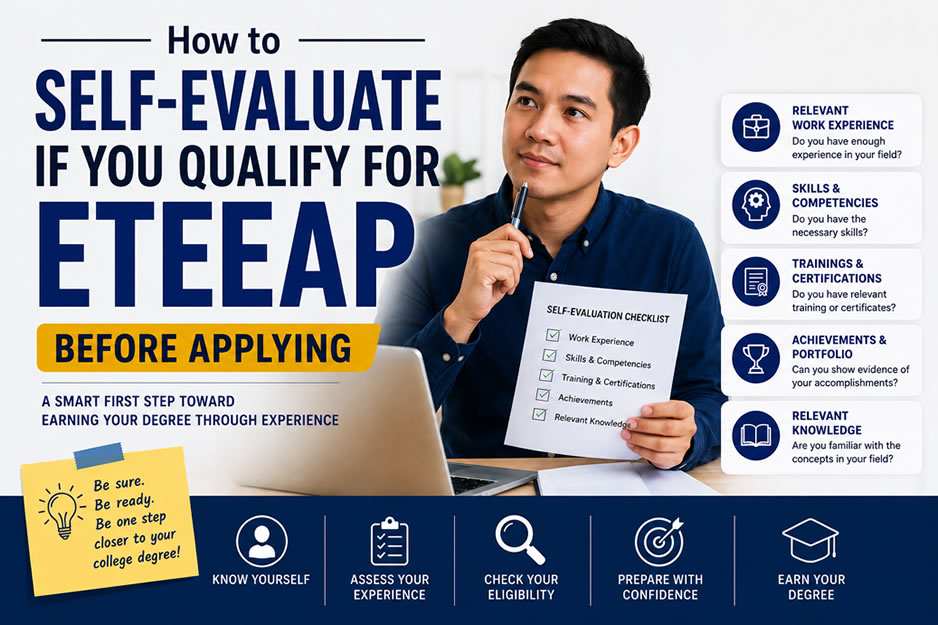

Many working adults dream of finally earning a college degree through the Expanded Tertiary Education Equivalency and Accreditation Program (ETEEAP). But before spending money, gathering documents, and applying to a university, one important question comes first:
“Do I actually qualify for ETEEAP?”
The good news is that you can already perform your own self-evaluation before contacting any school.
This article will guide you step-by-step on how to assess whether your work experience, training, and background match the ETEEAP requirements — using Hotel and Restaurant Management (HRM) as an example.
What is ETEEAP?
The Expanded Tertiary Education Equivalency and Accreditation Program (ETEEAP) is a government-recognized alternative education pathway in the Philippines that allows qualified working adults to earn a bachelor’s degree based on their work experience, skills, trainings, and prior learning. It is supervised by the Commission on Higher Education (CHED). (Commission on Higher Education)
Instead of starting college from zero, ETEEAP evaluates what you already know from years of actual work.
Why Self-Evaluation Matters Before Applying
Not everyone automatically qualifies for ETEEAP.
One of the biggest mistakes applicants make is choosing a degree that does not match their actual work experience.
For example:
- A person with 10 years of restaurant operations experience may qualify for HRM.
- But that same person may NOT qualify for Engineering or Information Technology.
ETEEAP is based on relevance of experience, not just years of employment.
That is why self-evaluation is very important.
Step-by-Step Guide: How to Self-Evaluate for ETEEAP
Let’s use Bachelor of Science in Hotel and Restaurant Management (BSHRM) as an example.
Step 1: Check the Basic National ETEEAP Requirements
Before evaluating your course, verify if you meet the minimum qualifications required by CHED.
Basic ETEEAP Qualifications
You are generally qualified to apply if you are:
- At least 23 years old
- A Filipino citizen
- A high school graduate, ALS passer, or PEPT passer
- With at least 5 years cumulative work experience
- Able to prove competency in your field through work records, training, or certifications
Self-Check Questions
Ask yourself:
- Am I already 23 years old?
- Do I have at least 5 years of work experience?
- Can I prove my employment history?
- Do I have certificates, seminars, or trainings related to my field?
If your answer is “YES” to most of these, proceed to the next step.
Step 2: Identify the Degree You Want
Now ask yourself:
“What degree truly matches my real work experience?”
This is the most important part.
For example, if you want to take:
Bachelor of Science in Hotel and Restaurant Management (BSHRM)
Your experience should be connected to:
- Hotels
- Restaurants
- Food service
- Catering
- Hospitality
- Tourism operations
- Kitchen operations
- Restaurant supervision
- Customer service management
- Food and beverage operations
Step 3: Match Your Actual Job Experience to the Course
Now create your own “Experience Matching List.”
Example Self-Evaluation for HRM
| Your Work Experience | Related to HRM? |
|---|---|
| Fast food crew | YES |
| Restaurant supervisor | YES |
| Hotel front desk | YES |
| Catering staff | YES |
| Barista | YES |
| Kitchen staff | YES |
| Resort operations | YES |
| Tourism assistant | YES |
| Sales clerk in appliance store | Maybe not |
| Construction worker | Not related |
The closer your experience is to the degree, the stronger your ETEEAP application becomes.
Step 4: Analyze Your Job Responsibilities
ETEEAP assessors do not only look at your job title.
They also study your actual responsibilities.
For example:
Weak Example
“Worked as restaurant staff.”
Strong Example
“Managed customer service operations, supervised food preparation, handled inventory management, coordinated dining services, and trained new employees.”
The second example demonstrates college-level competencies connected to HRM.
Self-Evaluation Tip
Write down:
- Your daily tasks
- Supervisory roles
- Technical skills
- Leadership responsibilities
- Decision-making duties
- Customer handling experience
- Operational management experience
These help prove your competency.
Step 5: Inventory Your Trainings and Certifications
ETEEAP values non-formal and informal learning.
This means seminars, workshops, and company trainings matter.
HRM-Related Certificates That Help
Examples include:
- Food safety training
- TESDA certifications
- Barista training
- Culinary workshops
- Hospitality seminars
- Customer service training
- Housekeeping NC II
- Food and Beverage NC II
- Bread and Pastry NC II
Even internal company trainings may help.
Self-Evaluation Question
Ask yourself:
“Can my trainings support my claim that I already possess HRM competencies?”
If yes, gather all certificates.
Step 6: Review Your Educational Background
Even under ETEEAP, schools still review your educational records.
You may be asked to submit:
- High school diploma
- Transcript of Records (if previously enrolled in college)
- ALS or PEPT documents
Previous college subjects may also be credited depending on evaluation.
Step 7: Prepare a Skills Portfolio
Think of this as your “proof file.”
A strong portfolio may include:
- Certificates of Employment
- Detailed job descriptions
- Performance evaluations
- Awards and recognitions
- Training certificates
- Photos of work activities
- Sample projects
- Recommendation letters
- Business permits (for self-employed applicants)
Many ETEEAP applicants underestimate how important documentation is.
Your portfolio tells your professional story.
Step 8: Evaluate if You Have College-Level Competence
This is the real heart of ETEEAP.
Ask yourself honestly:
Can I already perform professional-level HRM work?
Examples:
- Can you supervise restaurant operations?
- Can you manage customer complaints?
- Can you handle inventory systems?
- Can you lead staff?
- Can you apply hospitality standards?
- Can you manage food service workflows?
If your answer is yes, you may already possess competencies equivalent to many HRM subjects.
Step 9: Understand That Assessment Is Still Required
Self-evaluation only helps estimate your chances.
Final evaluation still belongs to the deputized college or university.
Schools may require:
- Interviews
- Written exams
- Skills demonstrations
- Portfolio defense
- Oral assessment
- Bridging subjects or enrichment classes
ETEEAP is not a “shortcut.”
It is a competency-based assessment system.
Step 10: Ask Yourself These Final Questions
Before applying, answer these honestly:
Is my work experience directly related to the course?
If yes, good sign.
Do I have at least 5 years cumulative experience?
If yes, proceed.
Can I document my experience?
Documentation is critical.
Do I possess actual skills and competencies in the field?
Experience alone is not enough.
Am I prepared for assessment and possible enrichment subjects?
Most ETEEAP applicants still complete some academic requirements.
Sample Self-Evaluation Scenario for HRM
Applicant Profile
- 12 years restaurant experience
- Started as service crew
- Became shift supervisor
- Completed TESDA Food and Beverage NC II
- Attended food safety seminars
- Previously completed 1 year college
Possible Result
This applicant has a strong chance of qualifying for BSHRM under ETEEAP because:
- Experience is directly related
- Work history exceeds minimum requirement
- Has documented competency
- Has relevant certifications
- Has supervisory experience
This does not guarantee automatic approval, but it strongly aligns with ETEEAP standards.
Final Thoughts
ETEEAP is designed for experienced professionals whose knowledge was gained through real-world work experience.
Before applying, take time to honestly evaluate:
- your experience,
- your skills,
- your certifications,
- and your readiness.
The best ETEEAP applicants are those whose professional lives already reflect the degree they want to earn.
Remember:
ETEEAP does not ask, “Did you attend school long enough?”
It asks:
“Have you already learned and practiced the competencies expected from a college graduate?”
If your answer is yes — then ETEEAP may be the opportunity you have been waiting for.
References: CHED ETEEAP Guidelines
- ETEEAP Qualification Standards
- University ETEEAP Requirements
- Competency-Based Assessment References
- Portfolio Evaluation Guidelines
- HRM Work Experience Equivalency References
- Real Experiences of ETEEAP Applicants


