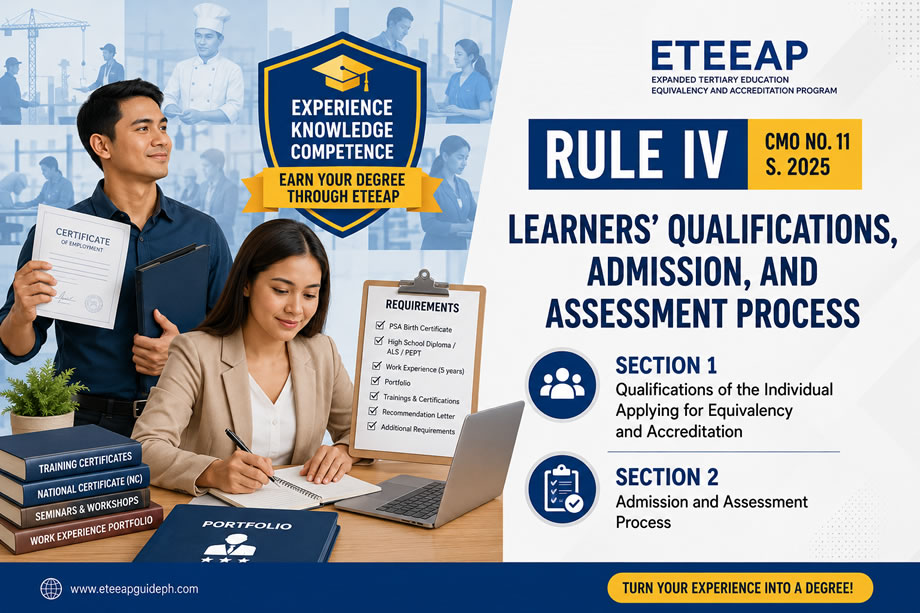
ETEEAP Learners’ Qualifications, Admission, and Assessment Process – RULE IV of ETEEAP CMO No. 11, Series of 2025

The Commission on Higher Education or CHED released CMO No. 11, Series of 2025 to strengthen and standardize the implementation of the Expanded Tertiary Education Equivalency and Accreditation Program (ETEEAP) in the Philippines. Rule IV focuses on one of the most important parts of the program — who can apply, what documents are required, and how the assessment process works.
For many working Filipinos, Rule IV is the section that determines whether they are qualified to finally earn a college degree based on years of work experience, prior learning, trainings, and industry expertise. While the legal wording of the CMO may sound formal and technical, the goal of this guide is to explain everything in simple and practical terms.
If you are planning to apply for ETEEAP, this guide will help you understand:
- Who qualifies for ETEEAP
- What documents you need to prepare
- How to obtain the required certifications
- What happens during assessment
- What schools look for during evaluation
- How equivalency credits are awarded
SECTION 1
Qualifications of the Individual Applying for Equivalency and Accreditation
Under Rule IV, Section 1 of CMO No. 11, S. 2025, applicants must meet specific qualifications before they can apply for ETEEAP.
Below are the qualifications listed in the CMO, followed by a simple explanation of each requirement.
1. Filipino citizen, residing in the Philippines or abroad
The applicant must be a Filipino citizen. This includes Filipinos currently living in the Philippines as well as Overseas Filipino Workers (OFWs) or immigrants living abroad.
This means ETEEAP is not limited only to people physically staying in the country. Many OFWs who already have years of experience in fields like hospitality, engineering, healthcare, information technology, maritime, logistics, business management, and education may qualify for the program even while working overseas.
Simple Explanation
As long as you are a Filipino citizen, you may apply regardless of where you currently live.
Examples of Qualified Applicants
- An OFW working as a hotel supervisor in Dubai for 10 years
- A Filipino nurse aide in Canada with TESDA certifications
- A call center operations manager in the Philippines
- A Filipino seafarer with extensive maritime experience
Documents Usually Needed
To prove Filipino citizenship, schools may ask for:
- PSA Birth Certificate
- Philippine Passport
- Dual Citizenship documents (if applicable)
2. At least 23 years old at the time of application
Applicants must be at least 23 years old before they can officially apply for ETEEAP.
The reason for this requirement is simple: ETEEAP is intended for working adults who already have substantial industry experience and prior learning gained outside traditional classroom education.
Simple Explanation
ETEEAP is not designed for fresh high school graduates or very young college students. The program recognizes real-world professional learning, which usually takes years to develop.
Example
If an applicant turns 23 next month but applies today, the school may ask them to wait until their birthday before processing the application.
Proof of Age
The most common document required is:
- PSA-issued Birth Certificate
3. Completed secondary education (High School Diploma, ALS Accreditation, or Philippine Educational Placement Test)
Applicants must have completed secondary education through any of the following:
- Traditional high school
- Senior High School
- Alternative Learning System (ALS)
- Philippine Educational Placement Test (PEPT)
This means applicants do not necessarily need a traditional educational background to qualify.
Simple Explanation
Even if you did not finish college before, you may still qualify as long as you completed secondary education through recognized alternatives.
This provision is especially helpful for working adults who stopped schooling due to financial problems, family responsibilities, or career opportunities.
Accepted Educational Proof
Possible documents include:
- High School Diploma
- Form 137 or Transcript of Records
- ALS Certificate
- PEPT Certification
How to Obtain These Documents
High School Records
Request them from your former high school registrar.
ALS Certification
Obtain it from the local Department of Education office or ALS learning center where you completed the program.
PEPT Results
These may be requested through DepEd regional offices.
4. Minimum of five (5) years of relevant work experience related to the degree being pursued
This is one of the most important ETEEAP requirements.
Applicants must have at least five years of work experience directly related to the degree they want to earn.
Simple Explanation
Your work experience must match the degree program.
For example:
| Work Experience | Possible Degree |
|---|---|
| Restaurant Manager | Hospitality Management |
| IT Support Specialist | Information Technology |
| Sales Supervisor | Business Administration |
| Construction Foreman | Civil Engineering Technology |
| Preschool Teacher | Education |
Why This Matters
ETEEAP evaluates prior learning gained from actual work experience. Schools need evidence that you already possess many of the competencies taught in college courses.
This is why relevance is extremely important.
Supporting Documents for Work Experience
Schools usually require:
- Certificate of Employment (COE)
- Service Record
- Resume or Curriculum Vitae
- Government IDs
- Company IDs
- Employment contracts
- Portfolio of work outputs
Sample Certificate of Employment (COE)
Below is a simple sample format commonly accepted by schools.
CERTIFICATE OF EMPLOYMENT
This is to certify that Juan Dela Cruz has been employed with ABC Corporation from January 2016 to March 2025 as Operations Supervisor.
During his employment, he handled team management, operational planning, quality assurance, and customer service supervision.
This certification is issued upon the request of the employee for ETEEAP application purposes.
Signed this 15th day of March 2025.
Human Resources Manager
ABC Corporation
Who Should Sign It?
The document should ideally be signed by:
- HR Manager
- Company Owner
- Immediate Supervisor
- Authorized company representative
Schools often prefer documents with:
- Company letterhead
- Official signature
- Contact details
- Company stamp or seal
SECTION 2
Admission and Assessment Process
Rule IV Section 2 explains the official admission and assessment procedures for ETEEAP applicants.
This is where schools evaluate whether your work experience and prior learning are equivalent to college-level competencies.
Submission of Application and Supporting Documents
Applicants must obtain an application form from the deputized Higher Education Institution (HEI) or download it from the CHED website.
The completed application must include several supporting documents.
Simple Explanation
This stage is basically your “proof submission” phase.
You are showing the school that:
- You meet the qualifications
- You have substantial work experience
- You completed trainings and certifications
- You possess competencies related to the degree
Required Supporting Documents Explained
1. PSA Birth Certificate
This verifies:
- Age
- Identity
- Filipino citizenship
How to Obtain It
You may request it from:
- PSA Serbilis Centers
- PSA online services
- Authorized PSA outlets
2. Proof of Secondary Education
This confirms that you completed high school or its equivalent.
Accepted documents may include:
- Diploma
- ALS Certificate
- PEPT Result
Important Tip
Prepare both original and photocopies because schools may require document verification.
3. Comprehensive Portfolio Showing Work Experience
This is one of the most important parts of ETEEAP.
A portfolio is a collection of documents proving your actual skills, achievements, and professional experience.
What May Be Included
- Certificates of Employment
- Awards and recognitions
- Work samples
- Project reports
- Photos of work activities
- Training certificates
- Performance evaluations
- Business permits (for entrepreneurs)
Simple Explanation
Think of your portfolio as your professional story.
The stronger and more organized your portfolio is, the easier it becomes for assessors to validate your competencies.
4. Relevant Trainings and Certifications
Applicants should submit evidence of formal, non-formal, or informal learning.
Examples include:
- TESDA National Certificates (NC)
- Company trainings
- Workshops
- Seminars
- Online certifications
- Industry licenses
Why These Matter
Trainings help strengthen your application because they demonstrate continuous professional development.
Even short seminars may help support your competency claims.
Sample Training Certification
CERTIFICATE OF PARTICIPATION
This certifies that Maria Santos participated in the “Advanced Customer Relations Management Seminar” conducted on February 10, 2025.
Issued this 10th day of February 2025.
Training Director
ABC Corporation
Important Reminder
Schools usually prefer certificates that contain:
- Full participant name
- Seminar title
- Date
- Organizer name
- Signature of authorized officer
5. Recommendation Letter from Employers or Industry Experts
Applicants need recommendation letters attesting to their competencies and qualifications.
Simple Explanation
This letter acts as a professional endorsement.
The school wants confirmation from credible people that you truly possess the knowledge and skills connected to your field.
Who May Write the Letter?
- Immediate Supervisor
- HR Manager
- Company Executive
- Industry Expert
- Business Owner
- Senior Professional Mentor
Sample Recommendation Letter
RECOMMENDATION LETTER
To Whom It May Concern:
I highly recommend Juan Dela Cruz for admission to the ETEEAP program. He has demonstrated excellent leadership, technical expertise, and operational management skills during his 8 years with our company.
He consistently handled complex responsibilities equivalent to supervisory and managerial competencies expected from degree holders in Business Administration.
Sincerely,
Operations Director
6. Additional Requirements from the School
CHED allows schools to request additional requirements.
These may include:
- Barangay Clearance
- NBI Clearance
- Passport
- Resume
- Certificates of Workshops
- Academic Records
- Proof of Competency
Why Schools Ask for More Documents
Every deputized HEI has its own evaluation system depending on the degree program.
For example:
- Engineering programs may require technical portfolios
- Education programs may require teaching demonstrations
- Hospitality programs may ask for operational experience evidence
Assessment Proper: How Schools Evaluate Applicants
After document submission, schools conduct assessments.
These assessments may include:
- Portfolio Evaluation
- Written Examinations
- Practical Demonstrations
- Oral Defense or Interview
Portfolio Evaluation
Assessors carefully review your submitted documents and experiences.
They determine whether your prior learning matches college learning outcomes.
Example
A restaurant operations manager with 12 years of experience may already possess competencies equivalent to courses in:
- Food Service Management
- Human Resource Management
- Operations Management
Written Examinations
Some schools conduct written tests to evaluate theoretical knowledge.
Possible Topics
- Industry concepts
- Technical knowledge
- Problem solving
- Communication skills
Not all programs heavily rely on exams. Some prioritize work experience more than academic testing.
Practical Demonstrations
Applicants may be asked to demonstrate technical skills.
Examples
- IT applicants may troubleshoot systems
- Hospitality applicants may demonstrate operational procedures
- Education applicants may conduct teaching demonstrations
This helps schools verify real-world competencies.
Oral Defense or Interview
Applicants may undergo interviews with a panel of assessors.
What They Usually Ask
- Work experiences
- Career achievements
- Leadership responsibilities
- Technical expertise
- Professional goals
Tip for Applicants
Be honest, confident, and specific when discussing your experience.
How Equivalency Credits Are Awarded
After assessments, the school determines how many academic credits can be granted based on prior learning and competencies.
Some applicants may receive:
- Large credit equivalencies
- Partial equivalencies
- Additional course requirements
Important to Understand
ETEEAP does not automatically grant a full degree instantly.
The school still checks whether all required learning outcomes are satisfied.
Some applicants may still need to complete:
- Bridging courses
- Additional subjects
- Capstone projects
- Internship requirements
Flexible Learning Pathways
CMO No. 11, S. 2025 also allows flexible learning methods such as:
- Online learning
- Mobile learning
- Blended learning
This is especially beneficial for:
- OFWs
- Working professionals
- Parents
- Entrepreneurs
The flexibility of ETEEAP makes degree completion more accessible for adult learners with busy schedules.
Summary
Rule IV of CHED CMO No. 11, Series of 2025 shows that ETEEAP is more than just an alternative college pathway — it is a recognition of real-world learning, professional growth, and years of industry experience.
For many Filipinos who were unable to finish college traditionally, ETEEAP offers a second chance to transform work experience into an accredited academic degree.
The key to a successful ETEEAP application is preparation.
Start organizing your:
- Employment records
- Training certificates
- Portfolio documents
- Recommendation letters
- Academic records
The stronger your documentation and demonstrated competencies are, the higher your chances of receiving significant equivalency credits toward your degree.
ETEEAP recognizes that learning does not only happen inside classrooms — it also happens through years of hard work, leadership, training, and real-life professional experience.