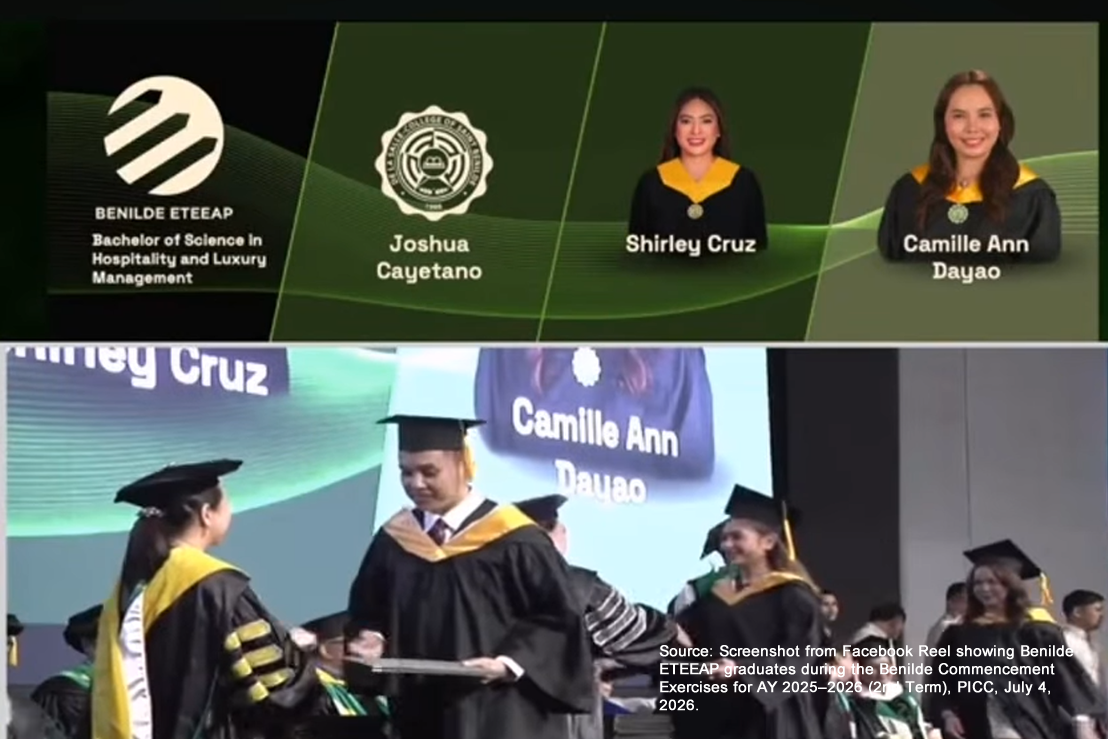

For many Overseas Filipino Workers (OFWs), government employees, private company workers, and professionals who were forced to stop schooling because of financial hardship or family responsibilities, finishing a college degree once felt impossible.
Today, that reality is changing through the Expanded Tertiary Education Equivalency and Accreditation Program (ETEEAP), a Philippine educational pathway that recognizes years of work experience, professional training, and acquired competencies as part of higher education equivalency.
A recent graduation from De La Salle-College of Saint Benilde, highlighted the emotional and inspiring success stories of ETEEAP graduates who finally achieved their long-awaited degrees while continuing to work and support their families. [1]
More importantly, the video reflects a truth now strongly backed by Philippine law: ETEEAP is legal, recognized, and institutionalized by the government.
Understanding What ETEEAP Truly Means
In the graduation program, Mr. Angelo Marco Lacson, Vice Chancelor for Academics of De La Salle-College of Saint Benilde described ETEEAP as follows:
ETEEAP is institutionalized under Republic Act 12124. It is a program that enables individuals to earn an academic degree through an assessment process that recognizes credits and grants equivalencies for knowledge, skills, and prior knowledge, prior learning acquired through relevant formal, nonformal, and informal education, trainings, and work experience.
That statement reflects the very spirit of ETEEAP as embodied in Republic Act No. 12124, officially known as the Expanded Tertiary Education Equivalency and Accreditation Program (ETEEAP) Act.
Under Rule 11, paragraph (w) of the Implementing Rules and Regulations of Republic Act No. 12124:
w. Expanded Tertiary Education Equivalency and Accreditation Program is a comprehensive alternative learning program for tertiary education based on academic equivalency, accreditation, validation, and recognition of prior learning or the knowledge and expertise derived from relevant work experiences and from formal, non-formal, and informal training that harness the student’s full potential.
It shall be used for identifying, assessing, validating, and assigning equivalent undergraduate level of prior learning from formal, non-formal and informal learning systems, relevant work experiences, and completion of competency enrichment and other program requirements toward the final granting of appropriate academic degrees to qualified individuals.
This legal definition is powerful because it formally acknowledges something many Filipinos have always known: learning does not happen only inside traditional classrooms.
A worker who has spent years managing operations, leading teams, handling finances, working in healthcare, engineering, hospitality, media, information technology, education, or government service has already gained substantial knowledge and expertise through real-world experience.
ETEEAP validates those competencies through a structured academic assessment process conducted by authorized colleges and universities recognized by the Commission on Higher Education (CHED).
The Legal Foundation of ETEEAP
Some critics in the past questioned whether ETEEAP degrees were truly legitimate because the program originally operated under Executive Order No. 330 issued in 1996 during the administration of former President Fidel V. Ramos.
That issue has now been decisively addressed.
On March 3, 2025, the Philippine government enacted Republic Act No. 12124, officially institutionalizing ETEEAP into national law.
This means ETEEAP is no longer simply an executive initiative. It is now a full legislative act passed by Congress and recognized nationwide.
The law reinforces the State’s constitutional duty to make education more accessible to Filipinos through flexible and innovative learning systems. It also acknowledges the importance of non-formal and informal learning acquired from workplaces, professional environments, trainings, and actual life experiences.
In practical terms, this strengthens the legitimacy of degrees earned through ETEEAP and further protects graduates from misconceptions or discrimination regarding the validity of their educational credentials.
Education for Working Adults, OFWs, and Professionals
One of the greatest strengths of ETEEAP is that it provides hope to people who once believed they had already missed their chance to graduate.
For OFWs working abroad, ETEEAP offers an opportunity to transform years of overseas experience into recognized academic achievement.
For government employees who entered public service early but were unable to finish college, ETEEAP opens doors for promotion, plantilla qualification, and career advancement.
For private sector workers balancing employment and family responsibilities, it becomes a second chance at completing a lifelong dream without abandoning their jobs.
Unlike the traditional four-year classroom route, ETEEAP focuses on competency assessment, portfolio evaluation, interviews, documentation, professional achievements, and academic validation.
This does not mean the process is “easy.” In fact, applicants still undergo rigorous evaluation to prove that their work experience genuinely matches the standards required for a college degree.
CHED itself explains that ETEEAP uses written tests, interviews, demonstrations, and other assessment methodologies to determine whether a candidate possesses the knowledge, skills, attitudes, and values equivalent to formal academic learning.
The program recognizes that learning gained through real-life work environments can be academically valuable when properly assessed.
Real Stories Behind the Graduation Ceremony
What made the Saint Benilde graduation reel especially moving was the visible reality behind the ceremony.
The graduates shown in the video were not merely students completing a traditional academic routine. Many were adults who balanced employment, family obligations, financial responsibilities, and years of sacrifice before finally wearing their graduation attire.
Some had likely spent decades postponing their education due to economic hardship or work demands. Others may have already built successful careers but still carried the unfinished dream of earning a college diploma.
These are the kinds of stories that demonstrate why ETEEAP matters.
The program is not about bypassing education. It is about recognizing learning that already happened through years of discipline, experience, leadership, and service.
Breaking the Stigma Around Alternative Learning
Unfortunately, some people still misunderstand ETEEAP.
There remains a stigma from individuals who assume that alternative learning pathways are shortcuts or academically inferior. However, Republic Act No. 12124 directly contradicts that misconception by formally institutionalizing the program under national education policy.
ETEEAP is not “fake education.”
It is a legally recognized academic equivalency program backed by CHED, authorized higher education institutions, and Philippine law itself.
The law exists because the government recognizes that Filipinos learn not only in classrooms but also in workplaces, communities, industries, and life itself.
A factory supervisor with 20 years of operational management experience possesses knowledge that deserves academic recognition.
A caregiver or nurse aide working abroad for years develops practical expertise beyond textbooks.
A media practitioner, entrepreneur, IT specialist, public servant, or hospitality worker accumulates competencies that can align with higher education standards.
ETEEAP gives these Filipinos a pathway to transform experience into academic qualification.
Why This Matters for the Future of Philippine Education
The institutionalization of ETEEAP represents a major shift in how education is understood in the Philippines.
It recognizes that many Filipinos are intelligent, capable, and highly skilled even if life circumstances prevented them from completing traditional schooling at the usual age.
In a country where many students stop college due to poverty or the need to work early, flexible educational systems are no longer optional — they are necessary.
ETEEAP provides dignity to working learners.
It validates years of sacrifice.
It proves that education can remain accessible even after setbacks, delays, migration, parenthood, or career interruptions.
Most importantly, it reminds Filipinos that it is never too late to finish what they started.
A Final Word to Aspiring ETEEAP Applicants
If you are an OFW, a government employee, a company worker, or someone who once stopped studying because life became difficult, ETEEAP may be the opportunity you have been waiting for.
The law is now clear.
ETEEAP is legal.
ETEEAP is recognized.
ETEEAP is institutionalized under Republic Act No. 12124.
And behind every graduation ceremony are real Filipinos proving that dreams delayed do not have to become dreams abandoned.
Education does not expire with age.
Experience matters.
Hard work matters.
Your years of dedication matter.
And through ETEEAP, those years can finally lead to the diploma you once thought was out of reach.
Facebook Reel Reference
Educational reference video from De La Salle-College of Saint Benilde Facebook Reel
How to Share With Just Friends
How to share with just friends.
Posted by Facebook on Friday, December 5, 2014


