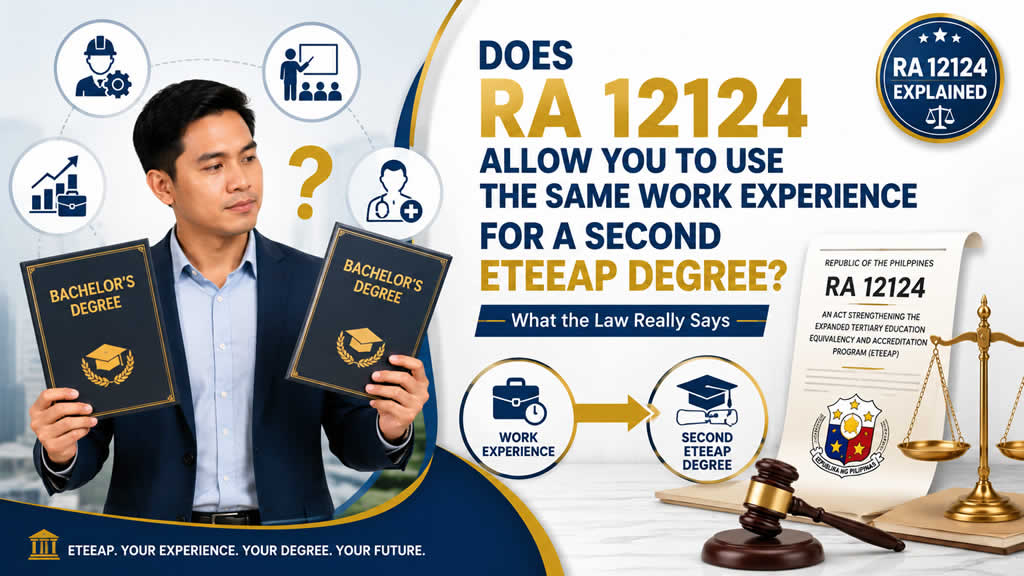
Does RA 12124 Allow You to Use the Same Work Experience for a Second ETEEAP Degree?

One of the most debated questions among ETEEAP applicants today is not whether they qualify for their first bachelor’s degree—but whether the law allows them to pursue a second ETEEAP degree using the same work experience they previously relied upon.
A common question goes like this:
“I already earned my first bachelor’s degree through ETEEAP using my ten years of work experience. Can I apply for a second ETEEAP degree using the same Certificate of Employment (COE) and the same work experience if it is also related to the second degree?”
A variation of the question is equally common:
“Does the first bachelor’s degree have to be earned through traditional schooling before I can apply for a second degree under ETEEAP, or can the first degree also be obtained through ETEEAP?”
Republic Act No. 12124 (RA 12124), which institutionalized the Expanded Tertiary Education Equivalency and Accreditation Program (ETEEAP), does not answer these questions directly. It neither expressly authorizes nor expressly prohibits the reuse of the same work experience in a second ETEEAP application.
Nevertheless, by carefully examining the language of Sections 4 and 5 of the law, we can arrive at a reasonable interpretation of what Congress intended.
This article discusses that interpretation.
The Relevant Provision of RA 12124
The key provision appears in Section 4 of RA 12124:
“A bachelor’s degree holder may apply for equivalency and accreditation of prior and work-based learning towards the grant of up to the second degree only: Provided, That such sources of learning are related to the second degree being sought under the ETEEAP.”
Meanwhile, Section 5(c) provides that applicants must possess:
“At least five (5) years of aggregate work experience in the industry related to the academic degree program or discipline where equivalency of learning is sought.”
These two provisions form the legal foundation for discussing second-degree applications under ETEEAP.
Does the Law Require the First Degree to Be Earned Through Traditional Schooling?
The answer appears to be no.
Notice that Section 4 simply refers to:
“A bachelor’s degree holder…”
The law does not distinguish between a bachelor’s degree earned through:
- traditional classroom education;
- ETEEAP; or
- any other legally recognized pathway leading to a bachelor’s degree.
Had Congress intended to limit the provision only to graduates of traditional higher education institutions, it could easily have stated:
“A bachelor’s degree holder who completed a traditional undergraduate program…”
Likewise, if Congress intended to prohibit graduates who already earned their first degree through ETEEAP from pursuing another ETEEAP degree, it could have expressly imposed that restriction.
It did neither.
Using the ordinary meaning of the statute, the phrase “a bachelor’s degree holder” naturally includes anyone who legally possesses a bachelor’s degree, regardless of the pathway through which that degree was earned.
Therefore, the law itself does not appear to distinguish between graduates of traditional programs and graduates of ETEEAP for purposes of applying for a second degree.
Does RA 12124 Prohibit Using the Same Work Experience Again?
This is where the discussion becomes particularly interesting.
Many people assume that once a Certificate of Employment has been submitted for one ETEEAP degree, it can no longer be used in another application.
However, the wording of the statute does not expressly support that conclusion.
Section 4 states that a bachelor’s degree holder may seek accreditation of:
“…prior and work-based learning…”
Notice what the law does not say.
It does not require:
- new work experience;
- additional work experience acquired after the first degree;
- work experience that has never been evaluated before; or
- a Certificate of Employment that has not previously been submitted.
Instead, Congress deliberately used the broader phrase “prior and work-based learning.”
The adjective “prior” refers to learning already acquired before the application is filed.
Nothing in the statute suggests that prior learning becomes legally unavailable simply because it has already supported an earlier ETEEAP application.
The Most Important Condition Is Relevance
The law instead imposes a different condition.
Section 4 immediately qualifies the right to seek a second degree by stating:
“…Provided, That such sources of learning are related to the second degree being sought under the ETEEAP.”
This qualifying clause is significant.
The statute focuses on whether the applicant’s prior learning is related to the second degree, not whether that learning has previously been presented as evidence.
If Congress intended to prohibit reusing work experience, it could have written something similar to:
“Provided, That such work experience has not previously been used in another ETEEAP application.”
No such restriction appears anywhere in RA 12124.
From a statutory interpretation standpoint, this omission is meaningful.
The law expressly regulates relevance.
It does not expressly regulate prior use.
Section 5 Supports the Same Interpretation
Section 5(c) requires applicants to possess:
“…at least five (5) years of aggregate work experience…”
Again, the law does not say:
- five new years;
- five additional years;
- five years acquired after the first degree; or
- five years not previously submitted.
It simply asks whether the applicant possesses at least five years of relevant aggregate work experience related to the degree being sought.
Therefore, if an applicant’s employment genuinely demonstrates competencies applicable to both:
- BS Business Administration; and
- BS Human Resource Management,
Section 5 does not expressly prevent the same employment from being relied upon in separate ETEEAP applications.
Is the Certificate of Employment What Is Actually Accredited?
No.
This is one of the most common misconceptions about ETEEAP.
The law does not accredit documents.
It accredits learning.
A Certificate of Employment merely proves that employment existed.
The actual subject of accreditation is the applicant’s:
- knowledge;
- competencies;
- skills;
- expertise; and
- prior learning derived from work and other learning experiences.
This distinction is extremely important.
A Certificate of Employment is evidence.
It is not the learning itself.
Consider This Example
Suppose an individual worked for ten years as a General Manager.
Their Certificate of Employment shows responsibilities involving:
- strategic management;
- human resource management;
- finance;
- purchasing;
- marketing;
- operations.
The same Certificate of Employment may reasonably be submitted as supporting evidence in an application for:
- BS Business Administration; and
- BS Human Resource Management.
However, approval is never automatic.
The deputized higher education institution must still determine whether the competencies demonstrated by that employment substantially satisfy the learning outcomes of each degree program.
The university may conclude that:
- the applicant qualifies for both;
- only one program;
- or neither program without additional evidence.
What If the Work Experience Is Unrelated?
Now consider a different situation.
An applicant worked exclusively as a Human Resource Officer for ten years.
That experience may strongly support an application for BS Human Resource Management.
However, the same employment may not sufficiently demonstrate the competencies expected in BS Information Technology.
In that situation, the issue is not whether the Certificate of Employment was previously used.
The issue is whether the applicant’s work-based learning is related to the second degree, exactly as required by Section 4.
A Careful Legal Interpretation
Based solely on the wording of Sections 4 and 5 of RA 12124, there appears to be no express prohibition against a bachelor’s degree holder—whether the first degree was earned through traditional higher education or through ETEEAP—applying for a second ETEEAP degree using the same employment and supporting Certificate of Employment.
The stronger interpretation of the statute is that the law evaluates prior and work-based learning, not whether the documentary evidence has been submitted before.
Likewise, Section 5 measures whether the applicant possesses at least five years of relevant aggregate work experience, not whether those years have previously supported another application.
At the same time, it is important not to overstate what the law provides.
RA 12124 does not expressly declare that “the same COE may be reused.”
Rather, the Act is silent on that specific issue.
The interpretation presented in this article is therefore derived from the wording of the statute, the conditions Congress expressly imposed, and those it chose not to impose.
The Final Decision Still Belongs to the Deputized HEI
Even if an applicant’s interpretation of the law is persuasive, ETEEAP remains a competency-based assessment system.
The deputized higher education institution retains the authority to determine whether an applicant’s work-based learning, portfolio, interviews, training, certifications, and other evidence collectively demonstrate equivalency with the learning outcomes of the degree sought.
Consequently, while RA 12124 appears to permit a second-degree applicant to rely on the same work experience when it is relevant to the second degree, the ultimate decision on whether that evidence is sufficient rests with the evaluating institution.
Final Thoughts
Republic Act No. 12124 reflects a shift from recognizing documents to recognizing learning.
The statute repeatedly speaks of prior learning, work-based learning, and aggregate work experience, emphasizing competency rather than the repeated submission of paperwork.
For this reason, the better reading of the law is that a bachelor’s degree holder—whether the first degree was earned through traditional education or through ETEEAP—is not automatically barred from relying on the same employment history in support of a second ETEEAP application. What matters is that the prior and work-based learning remains genuinely related to the second degree sought and that the deputized HEI determines it satisfies the competencies required under the program.
As with many questions of statutory interpretation, this conclusion is based on the language of RA 12124 itself. Until CHED issues further guidance or the courts interpret these provisions, applicants should also consult the ETEEAP office of their chosen deputized HEI regarding its assessment policies and documentary requirements.