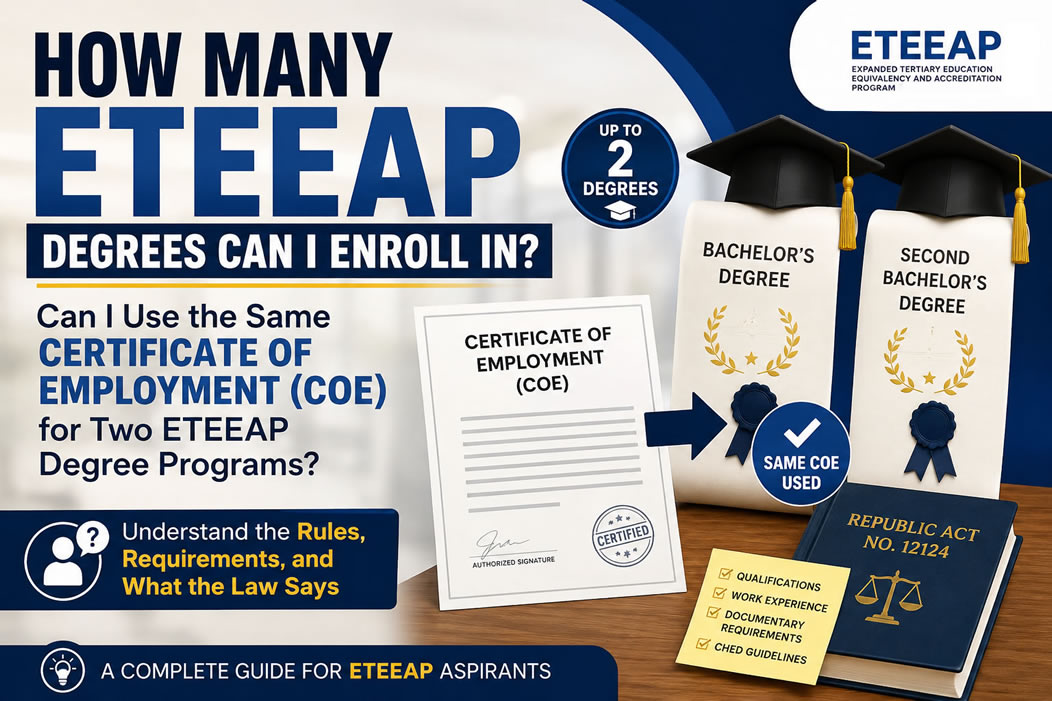

One of the most frequently asked questions among aspiring ETEEAP learners is this:
“Can I earn more than one bachelor’s degree through ETEEAP? If I have only one Certificate of Employment (COE), can I use it to apply for two different ETEEAP degree programs?”
It is an excellent question—and one that often sparks debate in online forums and social media groups. Some people believe that once your work experience has been used for one ETEEAP degree, it can no longer be used for another. Others argue that as long as the experience is genuine and relevant, there should be no reason why it cannot support more than one application.
So, what do the law and the implementing rules actually say?
In this article, we’ll examine the provisions of Republic Act No. 12124, the law that institutionalized the Expanded Tertiary Education Equivalency and Accreditation Program (ETEEAP), together with its Implementing Rules and Regulations (IRR). We’ll also look at how ETEEAP assessments are generally conducted by deputized higher education institutions (HEIs) to better understand how these situations are evaluated in practice.
Understanding the Purpose of ETEEAP
Before answering the question, it is important to understand what ETEEAP is designed to accomplish. ETEEAP is not a shortcut to earning a college degree. Rather, it is an alternative pathway that recognizes the knowledge, skills, competencies, and expertise individuals have gained through years of work experience, formal education, non-formal training, and informal learning. Instead of measuring only the number of years spent inside a classroom, ETEEAP evaluates whether an individual has already acquired learning outcomes equivalent to those expected from graduates of a bachelor’s degree program. Because of this, ETEEAP is fundamentally competency-based, not merely document-based.
What Does Republic Act No. 12124 Require?
Under Republic Act No. 12124, Section 5, applicants generally must satisfy several eligibility requirements, as quoted below:
Section 5. Qualifications. – Filipino citizens, whether residing in the Philippines or abroad, may apply for equivalency and accreditation if they satisfy the following requirements:
(a) Not less than twenty-three (23) years of age at the time of application;
(b) Completion of a secondary school program as evidenced by a high school diploma, or a result of the Philippine Educational Placement Test or Alternative Learning System Accreditation and Equivalency Assessment and Certification stating that the individual concerned is qualified to enter college; and
(c) At least five (5) years of aggregate work experience in the industry related to the academic degree program or discipline where equivalency of learning is sought: Provided, That the applicant may submit documentation of relevant training programs and other proof of forma, non-formal, and informal learning, as may be required by the deputized HEI including National Certificate or Certificates of Competency issued by the Technical Education and Skills Development Authority (TESDA).
Notice one important phrase:
“…related to the academic degree…”
The law emphasizes the relationship between the applicant’s experience and the specific degree program.
Interestingly, nowhere does the law state that:
- work experience may only be used once;
- a Certificate of Employment may only support one ETEEAP application; or
- an applicant is forever prohibited from using the same employment records in another ETEEAP assessment.
Instead, the law focuses on whether the prior learning is relevant to the degree being sought.
Can One Person Earn Two Bachelor’s Degrees Through ETEEAP?
The answer is:
Yes, it is legally possible.
Republic Act No. 12124 recognizes that a learner may pursue up to a second bachelor’s degree through ETEEAP, provided that the applicant independently satisfies the requirements for that degree.
This means the law does not limit ETEEAP to only one bachelor’s degree during a person’s lifetime. However, each degree application is assessed independently. Simply because someone qualified for one degree does not automatically mean they qualify for another. Each application must demonstrate competencies that align with the curriculum and learning outcomes of the intended degree program.
What If My Work Experience Covers Two Different Fields?
Let’s consider a simple example.
Suppose an individual worked:
- Human Resources Officer (2014–2019)
- Operations Manager (2019–2024)
This applicant possesses:
- five years of HR experience
- five years of operations experience
Such a learner may reasonably qualify for:
- BS Human Resource Management
- BS Business Administration or BS Operations Management
Each degree is supported by work experience that directly relates to its discipline. This situation generally presents little difficulty because the competencies required for each program are demonstrated through different periods of employment.
The More Interesting Question: Can the Same COE Be Used Twice?
Now let’s examine the scenario that raises the most questions. Imagine someone has worked for ten years as the General Manager of a company. Their Certificate of Employment states that they were responsible for:
- human resource management
- finance
- purchasing
- operations
- marketing
- strategic planning
- staff supervision
The question becomes:
Can this single Certificate of Employment be submitted in two separate ETEEAP applications?
For example:
- BS Business Administration
- BS Human Resource Management
The answer is:
Yes, it may be submitted in both applications.
However, this does not mean automatic approval.
A COE Is Evidence—Not the Entire Assessment
Many people mistakenly believe that ETEEAP revolves around submitting documents. In reality, the Certificate of Employment is only one piece of evidence. A deputized HEI typically evaluates several sources of proof, including:
- employment history;
- job descriptions;
- portfolio of work;
- professional certifications;
- seminars and training;
- interviews;
- competency assessments;
- demonstrations of skills;
- examinations, where applicable; and
- other supporting documents.
The purpose of the assessment is not simply to verify employment. Instead, it is to determine whether the applicant has already acquired the competencies expected of graduates of the degree program.
Why the Same Employment May Support Multiple Degrees
This is perhaps the most misunderstood aspect of ETEEAP. One job can involve multiple disciplines. For example, a business owner may simultaneously perform the roles of:
- marketing manager;
- HR manager;
- operations manager;
- purchasing officer;
- finance administrator; and
- strategic planner.
Likewise, a General Manager often acquires competencies across several functional areas. Because ETEEAP recognizes learning, rather than merely counting years of service, one employment experience may legitimately generate competencies applicable to more than one academic discipline. The key issue is not whether the applicant has only one employer. The real question is: Did that employment provide learning outcomes relevant to the degree being applied for? If the answer is yes, the same employment may support more than one ETEEAP application.
Does This Mean One COE Guarantees Two Degrees?
Absolutely not. Submitting the same COE twice does not guarantee approval for two degree programs. Each application undergoes its own evaluation. For instance, if an applicant seeks admission to:
- BS Information Technology
- BS Human Resource Management
but the Certificate of Employment only demonstrates HR-related duties, the applicant may qualify for Human Resource Management but fail to demonstrate sufficient competencies for Information Technology. The determining factor is always the relationship between the applicant’s actual competencies and the curriculum of the intended degree.
Can Someone Enroll in Two ETEEAP Programs at the Same Time?
This is another common question. At present, Republic Act No. 12124 does not expressly state that an applicant may simultaneously enroll in two ETEEAP bachelor’s degree programs. Likewise, the Implementing Rules and Regulations do not specifically authorize simultaneous enrollment. In practice, deputized HEIs generally process one ETEEAP application at a time because each program requires:
- comprehensive competency assessment;
- portfolio evaluation;
- curriculum mapping;
- interviews;
- recommendation by evaluators; and
- institutional approval.
For this reason, many institutions encourage learners to complete one ETEEAP degree before applying for another. Institutional policies may also govern whether simultaneous enrollment is allowed.
What If My Experience Is Split Between Two Careers?
Suppose a learner has:
- five years as an Information Technology Specialist; and
- five years as a Human Resource Officer.
This applicant may potentially qualify for both:
- BS Information Technology; and
- BS Human Resource Management.
Each degree has work experience directly related to its own discipline. However, suppose another applicant has:
- ten years working exclusively as a Human Resource Officer.
Could that applicant qualify for BS Information Technology? Probably not. Although the applicant exceeds the five-year work experience requirement, the experience does not demonstrate competencies associated with Information Technology. This illustrates an important principle: ETEEAP evaluates the relevance of experience—not merely its duration.
The Final Decision Always Belongs to the HEI
Even when an applicant appears highly qualified, no degree is granted automatically. Republic Act No. 12124 entrusts deputized higher education institutions with evaluating whether an applicant’s prior learning is substantially equivalent to the learning outcomes of the degree program. Each university may require different combinations of:
- portfolio assessments;
- competency demonstrations;
- interviews;
- examinations;
- practical assessments; and
- additional evidence.
Ultimately, the university—not the applicant—determines whether sufficient competencies have been demonstrated.
Final Thoughts
The introduction of Republic Act No. 12124 strengthened ETEEAP by placing competency recognition at the center of the program. Rather than focusing solely on classroom attendance, the law acknowledges that meaningful learning also takes place in the workplace, through professional practice, and through lifelong learning. For aspiring ETEEAP learners, this leads to an important takeaway.
A single Certificate of Employment is not consumed simply because it has been used in one application. If the employment genuinely demonstrates competencies relevant to another degree program, the same employment record may also be presented as supporting evidence in a separate ETEEAP application.
However, every application stands on its own merits. The decisive question is never, “Have I used this COE before?” Instead, the question is, “Does this employment demonstrate the competencies required for the degree I am applying for?”
That distinction is what makes ETEEAP a competency-based educational pathway rather than a document-based accreditation process.
As always, prospective applicants should consult the ETEEAP office of their chosen deputized higher education institution, as institutional assessment procedures and admission policies may vary while remaining consistent with Republic Act No. 12124 and its Implementing Rules and Regulations.


