
Have you been working for many years but never had the opportunity to finish a college degree?
The Expanded Tertiary Education Equivalency and Accreditation Program (ETEEAP) offers qualified Filipino professionals a chance to earn a college degree by recognizing the knowledge, skills, and competencies they have acquired through work experience, training, seminars, certifications, and self-directed learning.
For many working adults, ETEEAP provides an alternative pathway to a degree without having to start college from the beginning.
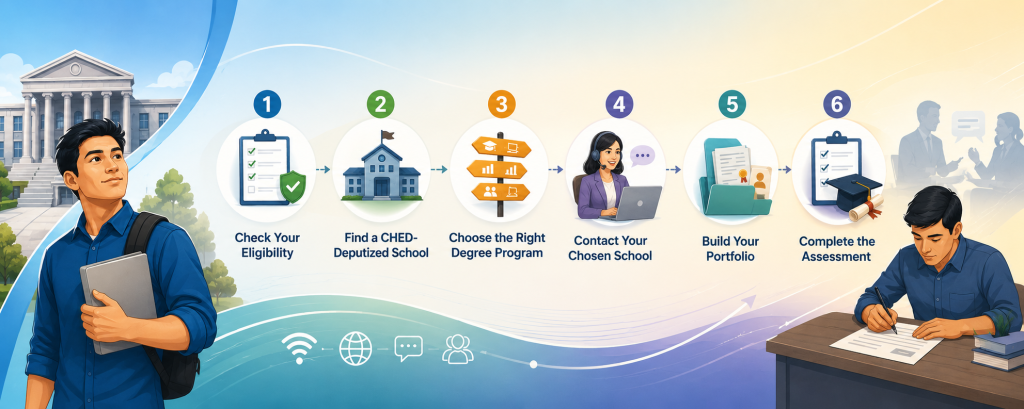
This guide explains the six major steps of the ETEEAP process and helps you understand what to expect as you begin your educational journey.
What is ETEEAP?
ETEEAP stands for Expanded Tertiary Education Equivalency and Accreditation Program. It is a special educational program that allows qualified individuals to earn academic credits for relevant work experience and prior learning.
Instead of spending four years in a traditional classroom setting, applicants undergo assessments that evaluate the competencies they have already developed in the workplace and through professional experiences.
The program is especially beneficial for:
- Working professionals
- Entrepreneurs
- Supervisors and managers
- Skilled workers
- Government employees
- Teachers and trainers
- Overseas Filipino Workers (OFWs)
If your professional experience matches a degree program offered by an authorized institution, ETEEAP may help you achieve your long-term educational goals.
Why Many Working Professionals Choose ETEEAP
Many adults postpone college because of financial challenges, family responsibilities, or career demands.
Years later, they discover that obtaining a college degree can help them:
- Qualify for promotions
- Meet employment requirements
- Improve earning potential
- Apply for government positions
- Continue to graduate studies
- Achieve personal fulfillment
ETEEAP provides a practical pathway for experienced professionals who want their years of hard work and learning to be formally recognized.
Step 1: Check if You Are Eligible for ETEEAP
Before anything else, you need to determine whether you meet the basic qualifications.
Although specific requirements may vary by institution, applicants are generally expected to:
- Be a Filipino citizen
- Be at least 23 years old
- Have completed high school or an equivalent educational level
- Possess at least five years of relevant work experience
Schools may also evaluate the quality and relevance of your work experience in relation to your chosen degree program.
For example, an individual with extensive experience in information technology may be a strong candidate for a technology-related degree.
Why Eligibility Matters
Understanding the eligibility requirements early helps you avoid unnecessary expenses and allows you to prepare the documents you may need during the application process.
Read Next: How to Check if You Are Eligible for ETEEAP
Step 2: Find a CHED-Deputized Institution
Not every college or university offers ETEEAP.
Only institutions authorized to implement the program may accept ETEEAP applicants.
These institutions are commonly referred to as CHED-deputized Higher Education Institutions (HEIs).
Different schools may offer different:
- Degree programs
- Assessment methods
- Tuition structures
- Learning schedules
- Support services
What to Look For in a School
When evaluating schools, consider:
- Availability of your preferred degree program
- Distance from your location
- Tuition and miscellaneous fees
- Reputation and support services
- Flexibility for working professionals
Choosing the right institution can make the application process smoother and more convenient.
Read Next: How to Find CHED-Deputized Schools Offering ETEEAP
Step 3: Choose the Right Degree Program
Selecting the right degree is one of the most important decisions in your ETEEAP journey.
Your work experience should closely align with the degree program you plan to pursue.
Examples include:
- IT professionals → BS Information Technology
- Office administrators → BS Business Administration
- Hospitality workers → BS Hospitality Management
- Trainers and educators → Education-related degrees
- Human resource professionals → Human Resource Management programs
Why Degree Matching Is Important
ETEEAP evaluates the knowledge and competencies you have already acquired.
The closer your professional background matches the degree program, the more likely your experience can be recognized during assessment.
A carefully chosen degree program can also support your future career goals.
Read Next: How to Choose the Right Degree Program Through ETEEAP
Step 4: Contact Your Chosen School
After identifying a suitable institution and degree program, contact the school directly.
School representatives can provide updated information regarding:
- Admission requirements
- Documentary requirements
- Application schedules
- Tuition and fees
- Assessment procedures
- Expected timelines
Questions You Should Ask
Before proceeding, consider asking:
- What documents are required?
- How long does the process usually take?
- Are there online options available?
- What are the estimated costs?
- What assessments will be conducted?
Obtaining accurate information early can save time and help you prepare more effectively.
Read Next: How to Contact an ETEEAP School and Ask the Right Questions
Step 5: Build Your Professional Portfolio
One of the most important components of your ETEEAP application is your portfolio.
The portfolio serves as evidence of your knowledge, skills, accomplishments, and professional growth.
Common portfolio documents may include:
- Resume or curriculum vitae
- Employment certificates
- Certificates of training
- Awards and recognitions
- Performance evaluations
- Professional licenses
- Work samples
- Job descriptions
- Seminar participation records
Why Your Portfolio Matters
Assessors use your portfolio to verify the competencies you claim to possess.
A well-organized portfolio can demonstrate years of practical learning and professional development.
Many successful ETEEAP applicants spend considerable time gathering and organizing their supporting documents.
Read Next: How to Build an ETEEAP Portfolio That Gets Approved
Step 6: Complete the Assessment Process
Once your documents have been reviewed, the institution may conduct various assessments.
These assessments are designed to determine whether your existing competencies satisfy academic requirements.
Depending on the school and degree program, assessments may include:
- Portfolio evaluation
- Interviews
- Oral examinations
- Written examinations
- Skills demonstrations
- Practical assessments
- Additional coursework or enrichment classes
What Happens After Assessment?
After completing all required evaluations, the institution determines the academic credits that may be awarded based on your demonstrated competencies.
You may then complete any remaining requirements identified by the institution before becoming eligible for graduation.
Read Next: What Happens During the ETEEAP Assessment Process?
Common Benefits of ETEEAP
Many professionals choose ETEEAP because it offers several advantages:
- Recognition of professional experience
- Faster path toward a college degree
- Flexible learning opportunities
- Career advancement potential
- Increased professional credibility
- Eligibility for positions requiring a degree
For individuals who have spent years building expertise in their field, ETEEAP provides an opportunity to convert experience into academic achievement.
Frequently Asked Questions
Is ETEEAP available for all degree programs?
No. Degree offerings vary depending on the institution and its authorization to offer specific ETEEAP programs.
Can OFWs apply for ETEEAP?
Many institutions accept applicants with overseas work experience, provided they meet program requirements and can provide supporting documentation.
Do I need to stop working while completing ETEEAP?
Many participants continue working while completing program requirements, although requirements vary by institution.
How long does the ETEEAP process take?
The timeline varies depending on the institution, degree program, assessment results, and completeness of documents.
Does ETEEAP result in a legitimate college degree?
Yes. Graduates who successfully complete the requirements receive a degree from the institution offering the program.
Start Your ETEEAP Journey Today
Thousands of professionals have spent years developing valuable skills and expertise in the workplace. ETEEAP offers an opportunity to have those competencies recognized through higher education.
The journey begins by understanding the process, preparing your documents, and selecting the right institution and degree program.
Use this guide as your roadmap and continue exploring the detailed articles linked in each step to learn more about every stage of the ETEEAP application process.